English
 Deutsch
Why structured photo documentation is becoming essential in warehouse operations
Learn why structured photo documentation is becoming essential in warehouse operations – and how it reduces disputes, strengthens handovers, and creates defensible evidence at scale.

Warehouses have always taken photos. A damaged pallet on arrival, a questionable label before dispatch, a container that needs documenting before sealing. The act itself is not new.
What has changed is the consequence of not managing those images properly.
As supply chains grow more complex and accountability expectations rise, informal photo habits are no longer sufficient. Images stored on personal phones, buried in chat groups, or scattered across email threads do not constitute documentation. They create fragments of evidence without structure – precisely the conditions under which disputes become costly and difficult to resolve.
This is one reason why searches for a warehouse photo app have increased. In most cases, the requirement is not better photography. It is a way to capture consistent, searchable visual proof that fits into real warehouse workflows and stands up when it matters.
From taking pictures to creating operational proof
The difference between photos and documentation is subtle but decisive.
A photo is an image but documentation is evidence tied to context.
In warehouse environments, context determines everything: which shipment the image relates to, who captured it, when it was taken, where in the process it occurred, and what happened next. Without that information, even clear photos lose operational value. With it, the same images become part of a reliable audit trail.
This is why structured photo documentation increasingly sits alongside quality controls such as receiving checks, outgoing inspections, and pre-shipment verification. A warehouse photo app is simply one mechanism for applying that structure consistently.
Where photo documentation delivers the most operational value
Receiving: Establishing the baseline condition
Inbound handling is often where liability begins. If goods arrive damaged and the warehouse cannot demonstrate their condition at arrival, responsibility can shift simply because verifiable evidence is missing.
A practical receiving workflow typically documents:
- The condition of the trailer or container on arrival
- Seal condition and seal numbers, where applicable
- Pallet integrity and packaging condition
- Visible moisture, compression, instability, or signs of mishandling
- Labels and identifiers before the goods are moved or unwrapped
This inbound baseline forms the first half of a closed-loop quality system, where receiving and dispatch records reinforce each other over time. In practice, the most reliable approach is to treat inbound and outbound checks as one connected process rather than separate tasks. This is explored more in detail here: Closing the loop: How photo documentation strengthens incoming and outgoing quality control
Dispatch: Proving the final condition before handover
Outbound issues typically surface later. By the time a customer raises a concern, the warehouse has already lost the moment when the strongest evidence could have been captured.
Dispatch documentation usually includes:
- Pallet condition before loading
- Packaging integrity and stability
- Correct routing labels and handling markings
- Load securing and distribution
- Final closure and sealing, where applicable
This becomes particularly important during container loading, where the sequence of loading and securing matters as much as the end state. Container loading documentation is covered in more detail here: How digital photo documentation is transforming container loading inspections
Claims and dispute resolution in warehouse operations
When disputes arise, the discussion tends to come back to one question: what did it look like at handover?
Without structured evidence, teams rely on memory, incomplete notes, or fragmented photos gathered after the fact. With structured documentation, evidence retrieval becomes fast, consistent, and defensible. This is why photo documentation functions as an operational defence mechanism in cargo claims, rather than a reactive reporting exercise.
What makes photo documentation usable at scale
Many warehouses already take photos. The weak point is not capture, but structure. Photos are rarely organised in a way that supports later retrieval, comparison, and reporting.
A practical warehouse photo documentation workflow should:
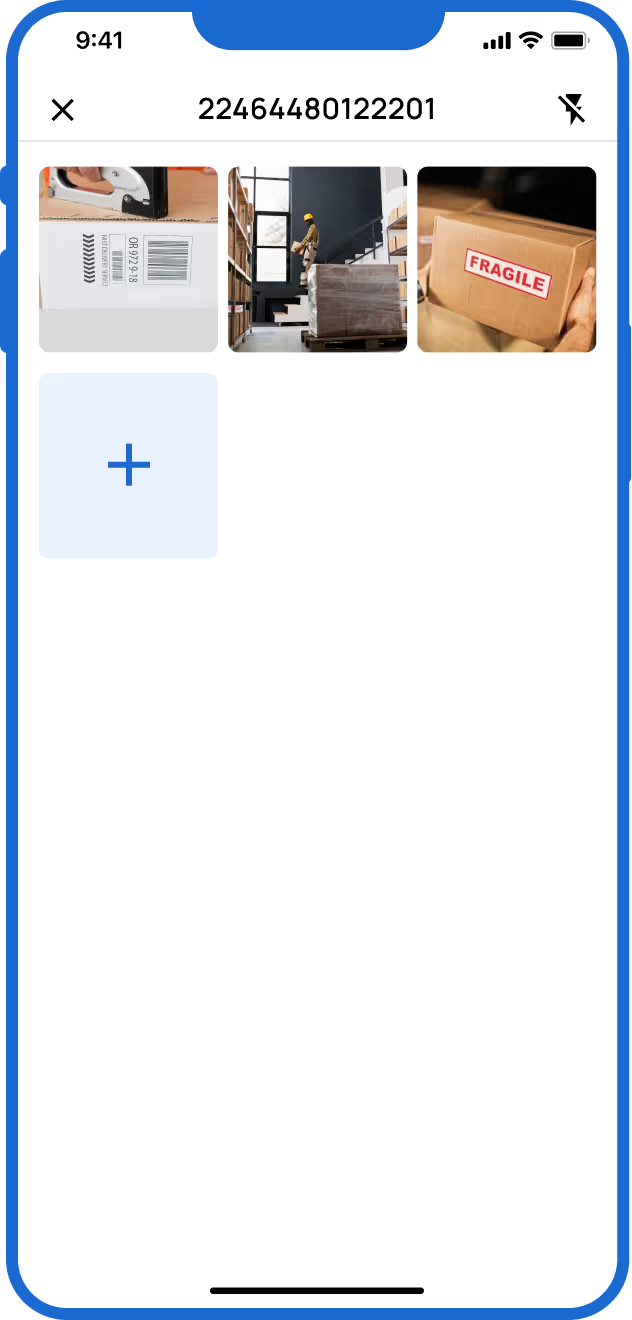
- Link images to a shipment, PO, pallet, container, or job reference
- Apply reliable time-stamping
- Include user attribution where needed
- Store content centrally rather than on personal devices
- Generate a clear photo report when required
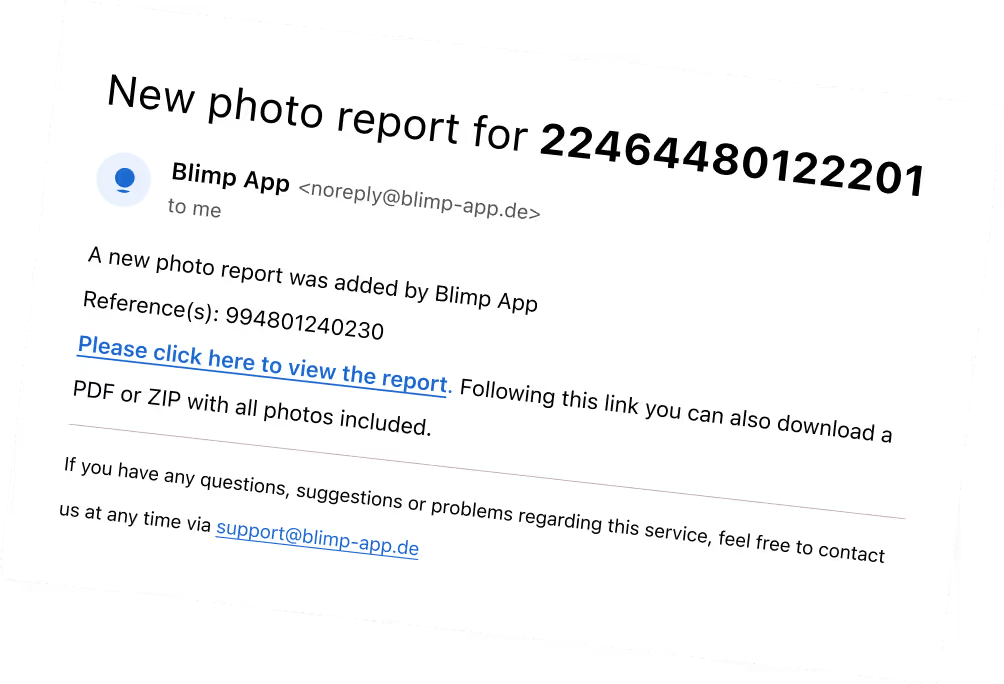
The reporting layer matters because most stakeholders do not want folders of images. They want a concise, readable summary that can be shared with customers, suppliers, or insurers, without additional explanation. This is exactly what photo reports are designed to provide.
For a practical framework on how to create reports that remain readable and defensible, this guide covers the best practices in a logistics and warehousing context: How to create effective photo reports that strengthen your logistics operations
Why shared-device workflows reflect warehouse reality
Warehouse operations are shift-based; devices are shared; workflows must remain fast.
Tools designed around individual, continuous use often fail in shift-based environments. On the warehouse floor, photo documentation tools such as warehouse photo apps must work under time pressure, across shifts, and across multiple users without friction. This is why shared-device workflows with quick session access are often a better fit for operational environments.
For a mobile-first view of how this typically works on the warehouse floor, this overview explains the approach in more detail: Blimp App overview
How Blimp supports structured photo documentation in warehouse operations
A useful tool should not force warehouses to invent new procedures. It should standardise what teams already do.
Blimp is designed around the reality of warehouse operations: floor staff take the photos, those photos need to be stored centrally, and they must be linked to the correct operational reference. The result is documentation that remains searchable, report-ready, and defensible, without relying on personal phones or manual reporting.
For readers who want a product-level explanation, the following pages provide a clear overview:
Conclusion: The value is not photos, it is certainty
Warehouses are not adopting structured photo documentation because they want more reporting. They are adopting it because operational ambiguity is expensive.
When documentation is consistent, time-stamped, and linked to the correct shipment context, it reduces disputes, accelerates investigations, improves consistency between shifts, and strengthens trust at handover points.
A warehouse photo app is simply the delivery mechanism. The real shift is from taking photos to establishing certainty.
For a broader view on why structured photo documentation has become foundational for warehouse operations, this article provides useful context: Why every warehouse needs a photo documentation app