English
 Deutsch
The standard tells you how to secure a load and nothing about proving you did
German law spreads load securing liability across the loader, the driver and the operator. The standards say how to secure. None of them says how to evidence it afterwards.
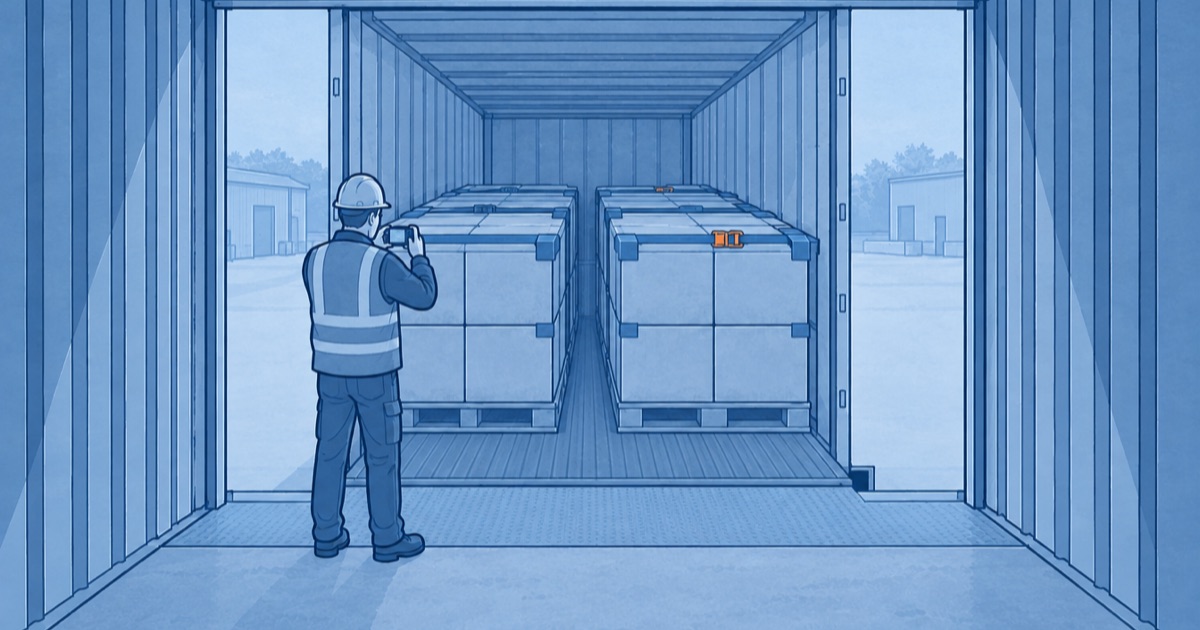
A vehicle you loaded on Tuesday is stopped on Thursday, three hundred kilometres away, and the officer thinks the load has shifted. Or it wasn't stopped, and an insurer is now asking about a load that is no longer in the state it left your dock in. Both are judging the load as it is now.
Either way, the question that reaches your dock is the same: what did the load look like when it left, and who can show it?
In short
- In the United States, 49 CFR Part 393 Subpart I sets the cargo securement standards, and § 392.9 bars a driver or carrier from operating a vehicle whose cargo is not properly distributed and secured. In Germany, § 22 StVO does the same job on the vehicle side.
- The party that loads the vehicle is answerable as well, because it knows how the load was built and controlled it at that moment.
- The standards (§ 393.102 in the US, the VDI 2700 series in Europe) say how to secure a load. None of them says how to prove afterwards that you did.
- After an incident, an investigation asks five questions, and four photographs taken at loading answer them: the load before securing, the securing applied, one detail of how it was applied, and the closed unit.
- The photographs have to carry the shipment or vehicle reference when they are taken, because the query months later will quote nothing else.
Driver, carrier or loader: who answers for the load
The law doesn't put load securing on one desk, in the US or in Germany. It spreads the duty across the vehicle side, the driver and whoever loaded the vehicle, and most operations get this wrong because each party assumes it belongs to another.
The federal rules put the immediate obligation on the vehicle side. In the United States, 49 CFR Part 393 Subpart I sets the cargo securement standards for trucks, tractors, semitrailers, full trailers and pole trailers. § 393.100 states the general requirement, § 393.102 sets the minimum performance criteria for securement devices and systems, and § 393.106 sets the general requirements for securing articles of cargo. That is the layer most people know about, because it is the one that produces a roadside violation.
There is a second federal duty aimed squarely at the driver. Under 49 CFR § 392.9 a driver may not operate a commercial motor vehicle, and a carrier may not require or permit one to, unless the cargo is properly distributed and adequately secured and the securement devices are in proper working order. The equivalent European provision, § 22 of the German StVO, works the same way and puts duties on both the driver and the vehicle operator (§ 22 StVO, read 9 September 2026).
The part that gets missed is that the party doing the loading is not outside the frame. Where a consignor or a warehouse loads a vehicle, they are responsible for handing over a load that can lawfully be carried. A driver who cannot see inside a sealed trailer they did not load is in a different position from one who watched it being built. Practically, responsibility follows knowledge and control, and the loading party has both at the moment that matters.
The technical answer to how, rather than who, sits below the regulation. In the United States the performance criteria are in the rule itself, and § 393.102 states them as forces the securement system has to withstand, expressed as fractions of the cargo weight in each direction. Read that section once. It is short, and it is the standard an inspector applies.
In Europe the same job is done by the VDI 2700 guideline series on securing loads on road vehicles, which is what inspectors, insurers and courts use to judge whether securing was adequate. Two sheets were reissued in 2026 and they are separate documents with separate dates. VDI 2700 Blatt 3.2, on the application, testing and marking of load-securing equipment, carries an issue date of February 2026. VDI 2700 Blatt 16, covering vans up to 7.5 tonnes gross mass, carries an issue date of June 2026 (both dates read from the VDI's own guideline pages, 9 September 2026). Trade coverage that puts both under one February date is wrong, and the June sheet is the one that catches operations running small vehicles that were previously outside any specific guideline.
So the rules say the load must be secured, the guidelines say how, and three parties can be answerable. None of them tells you how to show, four months later, that you did it.
What an investigation actually asks
It helps to stop treating compliance as a state and look at the questions asked afterwards, because they are specific and they are always the same ones.
- Was securing present at all? The bluntest question: straps, bracing, edge protection, anti-slip mat, or none of these.
- Was it appropriate to the load? This one is about method. Lashing over a load that needed blocking counts as securing, just the wrong kind.
- Was it correctly applied? Straps at the right angle, edge protectors where the strap crosses a corner, tension applied, blocking in contact with the load rather than near it.
- Was the load stable before securing was applied? Often the real issue. Securing compensates for a load that will not stay put on its own, and a badly built pallet cannot be strapped into stability.
- Who did it, and when? The custody question, which decides which of the three parties is answering.
Every one of those is visual. None is answered by a delivery note, a checklist tick or a policy document. All five are answered by photographs taken at the moment of loading, by the person who did the work.
Four images, and what each one is for
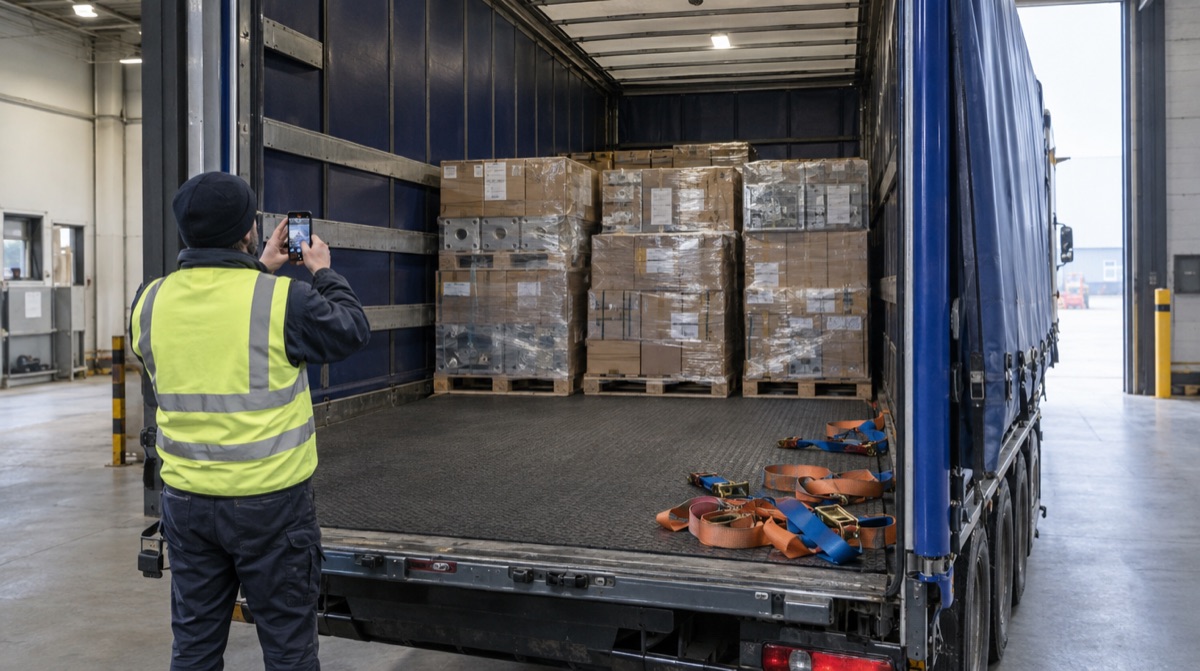
- The load in position before securing. This answers the stability question and shows how the goods were stowed, which no later photograph can reconstruct. It is the image most often skipped and the one investigations most often want.
- The securing applied, shot wide: the whole load with straps, bracing or blocking in place, framed so the arrangement is legible. This answers presence and method.
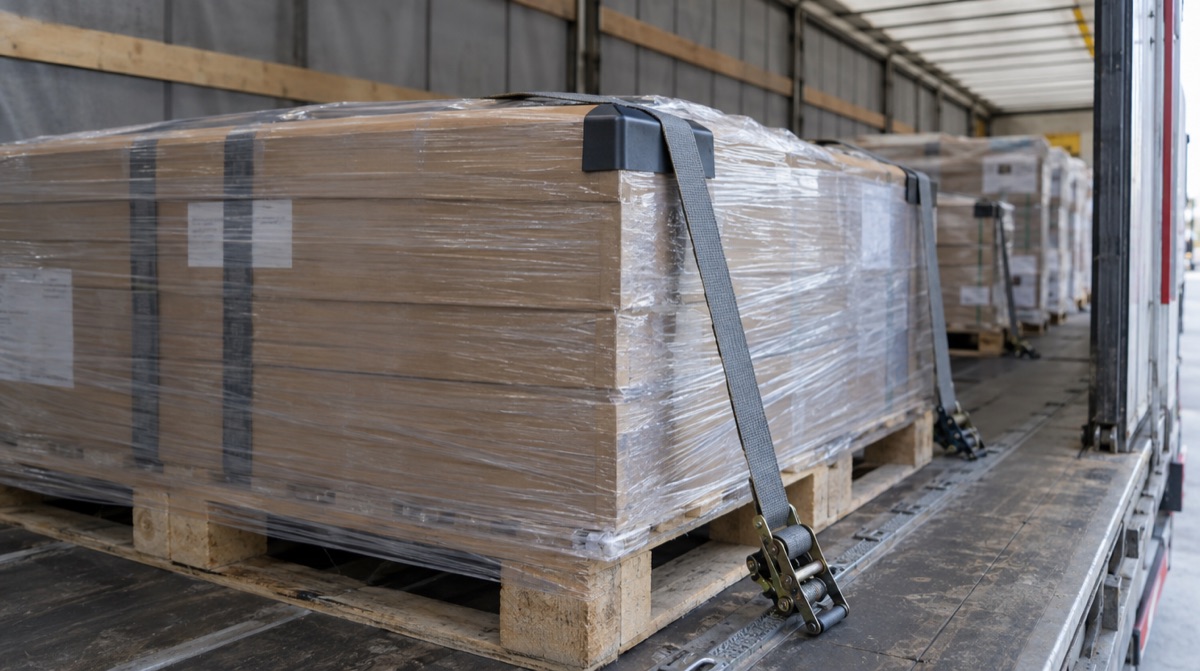
- One detail: a strap over an edge protector, a lashing point, a blocking beam in contact. This answers correct application, and it is the difference between showing that straps existed and showing that they were used properly.
- The closed unit: doors shut, the sheeted load, or the seal with its number readable. This fixes the state at the moment custody transferred.
| Question an investigation asks | Photograph that answers it |
|---|---|
| Was securing present at all? | The securing applied, wide |
| Was it appropriate to the load? | The securing applied, wide |
| Was it correctly applied? | One detail of a strap, lashing point or blocking beam |
| Was the load stable before securing? | The load in position before securing |
| Who did it, and when? | All four, tied to the shipment or vehicle reference with the time and the person who took them |
Taking all four takes well under a minute. They have to carry the shipment or vehicle reference when they are taken, because in four months the question will arrive quoting a registration number and nothing else.
It's tempting to photograph more, but forty images nobody can search are worth less than four that are indexed.
Why this is a defence rather than a courtesy
Shared liability is usually discussed as a burden. It is also why documentation pays.
When responsibility is distributed across the loader, the driver and the operator, each party's position after an incident depends on what the others can show. A party with a record does more than prove it complied. Without doing anything adversarial, it establishes where the boundary of its responsibility sat and what condition the load was in when it crossed.
A forwarder or warehouse operator who can produce four photographs of a load as it left moves the argument away from whether they secured it and onto what happened to it afterwards, which is a different conversation with a different burden.
There is a version of this that is more useful still: give the record to the driver at the moment of departure. A driver who leaves with a link to four images of the load they accepted has been shown the state of what they are carrying, and both parties now share an account of it. That is worth more than a signature on a note, and it takes the same thirty seconds.
Where the record has to live
Capture is the easy half, and the one people focus on. The question arrives months later, quoting a vehicle registration or a consignment number, and somebody has to produce the images while they still change the outcome.
Photographs on a supervisor's phone, or in a dated folder on a shared drive, technically exist, but someone who wasn't there and is under time pressure won't find them. This is why so many operations conclude that documentation did not work for them, when what failed was retrieval rather than capture.
That constraint is what Blimp is built around. Images take the shipment or vehicle reference at the moment of capture rather than being filed afterwards, so a photo report against that reference is produced in under a minute by whoever is handling the query. Capture runs on a shared device with PIN access instead of personal accounts, because a load securing record that lives on a departed employee's phone is not a record. It writes offline and syncs when the device finds signal, since loading bays are where reception ends.
Blimp doesn't assess load securing, though. There is no calculation of securing forces, no check against § 393.102 or VDI 2700, nothing that will tell you a lashing angle is wrong or that friction is insufficient. It documents what was done. If your requirement is verifying that securing is adequate before departure, that is a training and calculation problem, and there are load securing calculators and certified training providers who do exactly that.
The record protects good loading and exposes bad loading
Photographs don't make an unsafe load safe; only securing it properly does.
A badly secured load that is well documented is still badly secured, and now there is evidence of it. Teams who start this expecting the record to protect them have it backwards: the record protects you when you did the work properly and cannot otherwise prove it, and it exposes you when you did not.
Decide in advance how you'll handle that second effect, because for most operations it is the more valuable one. A photograph taken at loading that shows a strap over an unprotected edge is a training conversation that happens this week rather than an insurance conversation that happens after an incident.
Frequently asked questions
Who is legally responsible for load securing?
Responsibility is distributed rather than assigned to one party. In the United States 49 CFR Part 393 Subpart I sets the securement standard and § 392.9 puts a direct duty on the driver and the motor carrier. In Germany § 22 StVO does the equivalent on the vehicle side. In both systems the party that loads the vehicle is also answerable for handing over a load that can lawfully be carried, because they have the knowledge and control at the moment it is built.
What documentation is required for load securing?
No rule requires a photographic record. The obligation is to secure the load correctly, and the standards address method rather than evidence. A record is what lets you demonstrate compliance afterwards, which is a separate and more practical problem.
How do you prove load securing after an accident?
With a record made at loading, because nothing can be reconstructed afterwards. An investigation will ask whether securing was present, appropriate, correctly applied, and whether the load was stable before it was secured. Photographs of the load before securing, the securing applied, one detail of application, and the closed unit answer all four.
Do the securement rules apply to internal or works transport?
Both regimes address securing on road vehicles, so movements on public roads are squarely within them. Purely internal site movements sit outside road traffic rules, though the physics and the duty of care do not change. Operations that document both usually find the internal movements generate more incidents than expected.
What about loads a driver cannot inspect?
Sealed and pre-loaded units are exactly where the shared responsibility question bites, because the driver cannot verify what they are carrying. This is the strongest case for the loading party documenting, since it is the only record that will exist of a load nobody else saw built.
One thing to try on the next load
Photograph the load before the straps go on, then again after, and show both to whoever built it. The conversation that follows usually teaches more than the photographs do.