English
 Deutsch
Noting the damage on the delivery receipt is not filing a claim
Under 49 CFR 370.3 a damage notation on a delivery receipt is not a claim. The three things a claim must contain, and why the evidence has to exist before you can write one.

A pallet of coated sheet arrives on a Tuesday. It is wrapped and the driver is waiting to leave, so the receiver signs and nobody opens it. The following Monday someone cuts the wrap and finds a crushed corner. They write "damaged" on the delivery paperwork, take a photo on their phone and tell purchasing, which feels like reporting it. The carrier, meanwhile, has heard nothing.
Six days later the team still has every fact it needs. What it doesn't have is a claim. A remark on your own paperwork and a picture on someone's phone are internal records, and federal regulation lists exactly those documents among the ones that don't count.
In short
- Under 49 CFR § 370.3(b) a cargo claim is a written communication to the carrier that identifies the shipment, asserts the carrier's liability and demands a specified or determinable amount of money.
- § 370.3(c) says delivery receipt notations, bad order reports and carrier inspection reports do not, standing alone, meet that standard. The exception your dock writes is evidence, and it starts no clock in your favour.
- The filing deadline is in your bill of lading or the carrier's tariff. The Carmack Amendment only sets a floor of nine months to file and two years to sue after a claim is declined, and concealed-damage windows in tariffs are often much shorter.
- International road freight in Europe runs on CMR Article 30 instead: reservations at delivery for visible damage, seven days in writing for hidden damage, 21 days for delay.
- A claim template with six fixed elements, and photographs tied to the bill of lading number when they are taken, let a receiving supervisor file on the day the damage is found.
What counts as a claim, and what only looks like one
Federal regulation sets out what a carrier is allowed to treat as a claim. There are three elements, and all three have to be there.
A written communication from a claimant, filed with a proper carrier within the time limits in the bill of lading or contract of carriage, containing facts sufficient to identify the shipment, asserting liability for the alleged loss, damage, injury or delay, and making claim for the payment of a specified or determinable amount of money (49 CFR § 370.3(b), read 9 September 2026).
Put plainly, the claim has to identify the shipment, say the carrier is liable, and ask for a number.
Now the paragraph almost nobody in receiving has read. The next one says that bad order reports, appraisal reports of damage, notations of shortage or damage on freight bills or delivery receipts, and inspection reports issued by carriers or their inspection agencies do not, standing alone, satisfy those requirements. It says so whether or not the loss is expressed in dollars and cents (49 CFR § 370.3(c)).
Read that against what your dock actually produces: the exception noted on the delivery receipt, the bad order report, the carrier's own inspection write-up. The regulation names every one of them as something that does not count as a claim.
They are still worth doing. A noted exception is evidence, and it is close to the only contemporaneous evidence most receivers create. It just does not start any clock in your favour, and teams routinely believe that it does.
The deadline is in your bill of lading, not in the statute
There is no federal filing deadline for cargo claims. There is a floor.
The Carmack Amendment says a carrier may not provide for a period shorter than nine months for filing a claim, or shorter than two years for bringing a civil action after the claim is disallowed (49 U.S.C. § 14706(e), read 9 September 2026). Everything above that floor is contractual. The real number sits in the bill of lading or the carrier's tariff, and nine months is common rather than universal.
Concealed damage is where this bites. Federal regulation sets no discovery deadline for damage that could not be seen at delivery. Carrier tariffs do, they are often much shorter than the claim-filing period, and they vary between carriers on the same dock. If you do not know what yours says, that is the single most useful thing in this article to go and find out.
A claim that goes quiet is easy to lose track of, and the regulation sets the carrier a timetable too. Once a properly filed claim reaches it, the carrier has 120 days to pay, decline or make a firm compromise settlement offer in writing. If it cannot, it owes you a written status explanation every 60 days (49 CFR § 370.9). Put day 120 in the diary on the day you file.
International road carriage into Europe works on a different logic and much shorter intervals. Under Article 30 of the CMR Convention, reservations for apparent loss or damage are due at the time of delivery, seven days in writing for damage that is not apparent, and twenty-one days for delay, and acceptance without reservation is prima facie evidence that the goods were received as described in the consignment note (CMR Convention, Article 30, UN Treaty Series, read 9 September 2026). If any of your freight crosses a European border by road, your team is working to two rulebooks.
| US domestic (Carmack, 49 CFR Part 370) | International road in Europe (CMR) | |
|---|---|---|
| What has to be sent | A written claim that identifies the shipment, asserts liability and demands an amount | A reservation to the carrier, in writing for damage that is not apparent |
| Visible damage | Note it on the receipt as evidence, then file the claim within the bill of lading period | Reservation at the time of delivery |
| Hidden damage | The concealed-damage window in the carrier's tariff, which varies by carrier | Seven days after delivery |
| Delay | Part of the claim | 21 days |
| Statutory minimum | At least nine months to file and two years to sue after the claim is declined | None beyond the Article 30 intervals |
The clean receipt problem
What happened at the dock on Tuesday decides how much the Monday discovery is worth.
To recover under Carmack you have to make out a prima facie case, and the Supreme Court set out its elements in Missouri Pacific Railroad Co. v. Elmore & Stahl, 377 U.S. 134 (1964): delivery to the carrier in good condition, arrival in damaged or deficient condition, and the amount of damages.
A delivery receipt signed clean is evidence against the second element. The carrier will produce it, and it will say that a representative of your company looked at the freight and raised nothing. Your answer has to be that the damage could not be seen, and that answer is far more convincing when you can show the load as it arrived, wrapped and intact, before anybody touched it.
So the photograph that answers a problem found on Monday is one taken on Tuesday, of a pallet with nothing visibly wrong with it. Few teams take it, because at the time there is no reason to.

What the claim has to contain
The regulation sets a floor of three elements. A claim that only clears the floor tends to get declined. In practice a claim does its job when it carries six things, and all six can be assembled in a few minutes when the underlying record exists.
- The shipment identifiers: bill of lading number, pro number, purchase order and delivery date. This is the "facts sufficient to identify" element, and the cheapest one to get right.
- What was found, described rather than characterised. "Two cartons on the top layer crushed on the near-side corner, contents deformed" is an observation the carrier can check. "Damage in transit" is a conclusion you are asking them to accept.
- When it was found, and when it could first have been found. This is the sentence that answers the clean receipt. If the pallet was shrink-wrapped and banded, say so, and say when the wrap came off.
- An explicit statement that you hold the carrier liable. Without it you have sent information rather than a claim, and the regulation cares about the difference.
- A specified or determinable amount, the element that trips up careful people. You cannot file a placeholder while you investigate. State the figure, or the basis on which it can be calculated, such as invoice value of the affected units plus freight. A letter saying you will advise once you know more does not qualify under § 370.3(b) and does not stop the tariff clock.
- A statement that evidence exists and can be produced, with when the photographs were taken. You don't need to attach them yet. Offer inspection of the goods before they are moved, repaired or scrapped too, which costs nothing and removes the carrier's strongest later argument.
Notice what the specified-amount rule does to your operation. It moves valuation to day one. You cannot write the claim until you know what was affected and how much of it, which means the count and the condition record have to be done properly at the point of discovery rather than after somebody asks.
Write it once, before you need it
The practical move is smaller than it sounds. The six elements never change between incidents. Only the specifics do.
Most of the hard decisions about a claim can be made on a quiet day, when nothing is damaged. Decide then what each of the six slots needs and where the template lives, and keep it with your receiving records. When someone later finds a discrepancy, the supervisor only adds what is specific to that load, including an amount in the slot made for it. Nobody has to stop and ask legal what a claim should contain, and nobody has to be brave about committing to a number.
Attach a rule to it. Any discrepancy found at any point after unloading triggers the template the same day, whether or not anyone has decided to pursue it. Filing costs you a few minutes and commits you to nothing you cannot withdraw. Missing the tariff window is not reversible.
Teams that handle this well have made the process boring. It goes out, it goes in the file, and most are never pursued because most damage is minor. The ones that matter are already protected.
Where the evidence has to already be
The claim makes the assertion and the evidence has to carry it. Filing is usually when a team finds out whether it has any.
If your record of the delivery is a signed receipt, you can establish that a driver was present and that somebody signed something. You cannot establish the condition of the goods at handover, which is the fact in dispute.
What resolves it is a small, consistent set of images: the trailer or container on arrival before unloading begins, the load in position before anything is moved, the damaged item with something in frame for scale, the label or identifier that ties the images to the shipment, and the seal with its number readable if the unit arrived sealed.
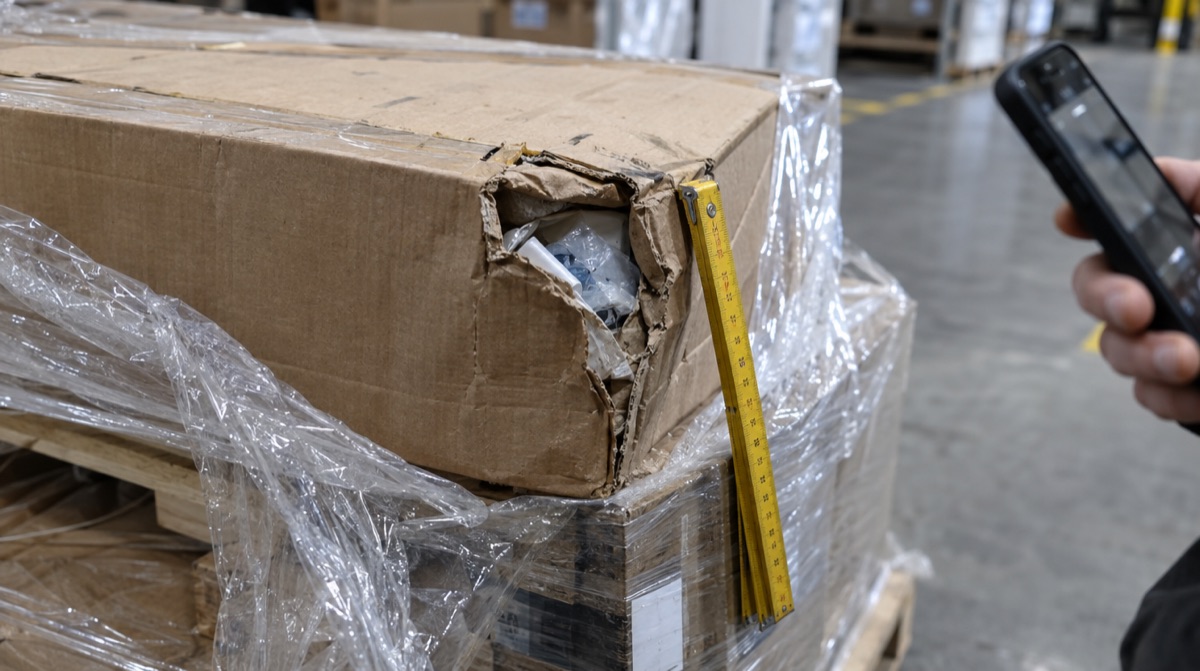
Those five images have to be attached to the shipment reference at the moment of capture rather than sorted into a folder later. On the day the claim is written, the person writing it will search by the bill of lading number and by nothing else.
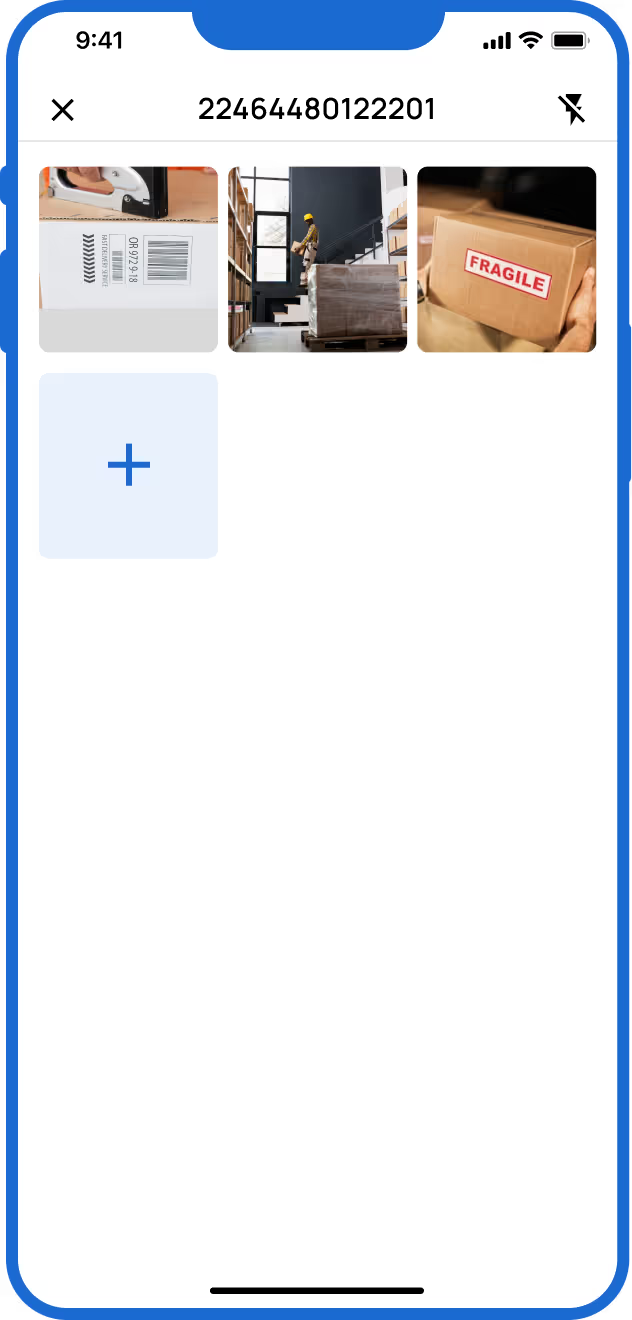
Blimp is built around that constraint. Capture happens on a shared device with PIN access rather than personal accounts, so the record belongs to the operation rather than to whoever was on shift. Images sync when the device finds signal, because the receiving dock is where reception ends. Each photograph carries the shipment reference from the moment it is taken, which is what makes a photo report against a bill of lading number a thirty second job rather than an afternoon.
Blimp doesn't file the claim, though. There is no claims workflow, no deadline tracking against carrier tariffs and no escalation. The filing is a process your team owns, and what a documentation tool adds is that the evidence is there to attach when the supervisor opens the template.
A properly filed claim also does not win anything by itself. It preserves your position. Recovery still depends on liability, on any limitation in the bill of lading, and on whether the damage was caused by something the carrier is answerable for. Plenty of well-founded claims fail on the merits. What does not have to happen is a good claim failing because the paperwork was a notation on a delivery receipt.
Some of your transit damage happened in your own yard
Teams who start photographing goods before anything is moved usually find, within a quarter, that some of the damage they had been claiming for happened during unloading, in their own yard, with their own forklift.
That is useful, and it is also why the practice gets quietly avoided. Knowing changes what you can honestly claim. It also stops you spending four months arguing something you were always going to lose, and it points at a handling problem you can fix. Both are worth more than the claim.
Frequently asked questions
What legally counts as a cargo claim in the United States?
A written communication to the carrier, inside the time limit in the bill of lading, that identifies the shipment, asserts the carrier's liability, and demands a specified or determinable amount of money (49 CFR § 370.3(b)). All three elements are required, and a letter missing one of them doesn't count as a claim.
Does noting damage on the delivery receipt protect us?
Not on its own. 49 CFR § 370.3(c) expressly says that notations of shortage or damage on freight bills or delivery receipts, bad order reports and carrier inspection reports do not, standing alone, meet the filing requirements. Keep noting exceptions, because they are good evidence. Do not mistake them for a filing.
How long do we have to file?
Whatever your bill of lading or the carrier's tariff says, subject to the statutory floor in 49 U.S.C. § 14706(e) of nine months to file and two years to sue after disallowance. Concealed damage often carries a much shorter tariff window, and it differs between carriers, so read the ones you actually use.
Can we file before we know the value of the loss?
Only if the amount is determinable from what you have sent. A figure is safest, and a stated basis such as invoice value of the affected units plus freight will usually do. A letter promising a number later does not satisfy § 370.3(b).
Do the same rules apply to shipments into Europe?
No. International road carriage runs on the CMR Convention, where reservations are due at delivery for apparent damage, within seven days in writing for damage that is not apparent, and within twenty-one days for delay. If you ship both ways, your team needs both procedures written down.
One thing to check this week
Ask whoever received your last damaged delivery two questions: what did we send the carrier, and does it name an amount?
If the answer is a photograph and a note on the receipt, nothing has been filed yet.